
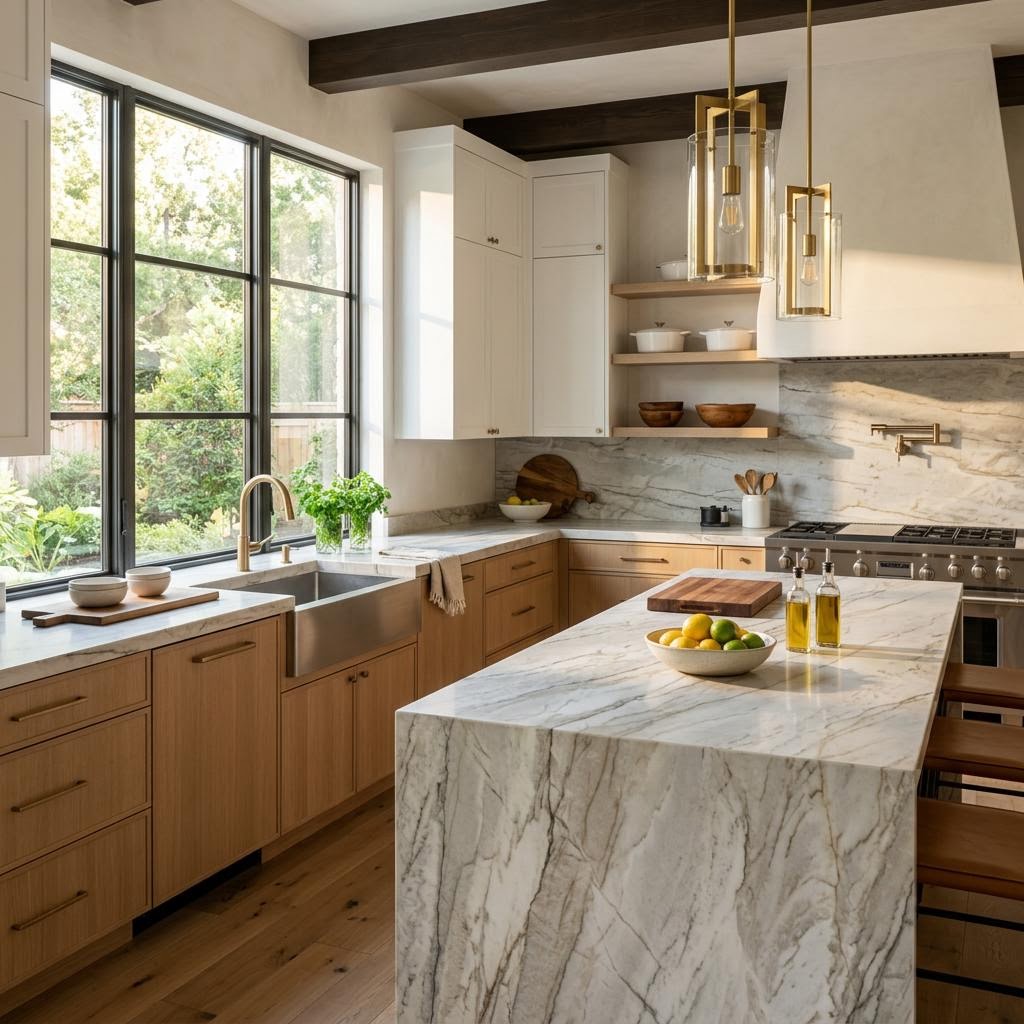
Worried Your New Counters Are Too Heavy?
If you're like many Odessa and Midland homeowners planning a kitchen remodel, have you wondered whether your cabinets are truly strong enough to carry the weight of granite or quartzite every single day? When that question gets overlooked, small installation shortcuts can turn into cracked stone, shifting seams, sagging cabinets, and repairs that cost far more than doing it right the first time. In West Texas homes, where remodels are meant to add long-term value, a heavy countertop installed without proper support can quietly become a structural problem hiding in plain sight.
Here's what decades of helping West Texas homeowners has taught us: beautiful countertops only perform as well as the support system underneath them.
Since 1988, Permian Basin homeowners have trusted The Design Gallery because we help them look beyond surface-level style and make smart remodeling decisions about cabinet integrity, stone weight, substrate needs, spans, overhangs, and long-term installation performance.
Why countertop weight matters more than most homeowners think
It is easy to fall in love with a slab and assume the rest will take care of itself. But in real-world remodeling, heavy countertop materials place very different demands on a kitchen than laminate or tile ever did. Granite, quartzite, quartz, and other premium surfaces can weigh hundreds of pounds once fabricated and installed. That means your cabinet boxes, mounting surfaces, wall attachment points, and overhang supports all have to work together.
In Odessa and Midland homes, we often see homeowners replacing older tops with much heavier materials as part of a full kitchen remodel. That is where planning matters. If cabinets are out of level, poorly anchored, water-damaged, or built with weaker construction, the countertop can be put under stress before anyone even notices. Stress points tend to show up around sink cutouts, dishwasher runs, cooktop openings, seams, and unsupported overhangs.
That is why countertop weight support installation Odessa TX is not just about setting a slab in place. It includes evaluating:
- Cabinet box construction and material thickness
- Whether cabinets are level across the entire run
- Wall anchoring and fastener strength
- Support for spans over dishwashers and open areas
- Bracing for bar tops, islands, and seating overhangs
- The condition of existing cabinets before new stone is installed
If one part of that system is weak, the countertop may still look fine on day one. The problem is what happens after months or years of normal use.
How cabinet support affects granite and quartzite performance
Granite and quartzite are both excellent choices for West Texas kitchens, but they are not forgiving when support is inadequate. Quartzite in particular is prized for its beauty and durability, yet like any natural stone, it can be vulnerable if a cabinet run is twisted, an overhang is under-braced, or a span lacks reinforcement. Homeowners in the Permian Basin often focus on stain resistance, color, and edge profile first, which makes sense. But structurally, the hidden support details are just as important as the slab selection itself.
Here is the practical truth: cabinets must provide consistent, even support. A strong cabinet is not just about doors and drawers looking nice. It is about whether the box is square, whether the top edges are flush, and whether weight transfers properly to the floor and wall. During a remodel, this may mean repairing existing cabinetry, adding reinforcement, or replacing sections that are no longer suitable for heavy stone.
For example, an island with a dramatic overhang may need steel brackets or other engineered support. A long run over a dishwasher may need additional structural planning. A farmhouse sink cutout can also change how weight is distributed. These are not “extras.” They are part of a sound countertop installation plan.