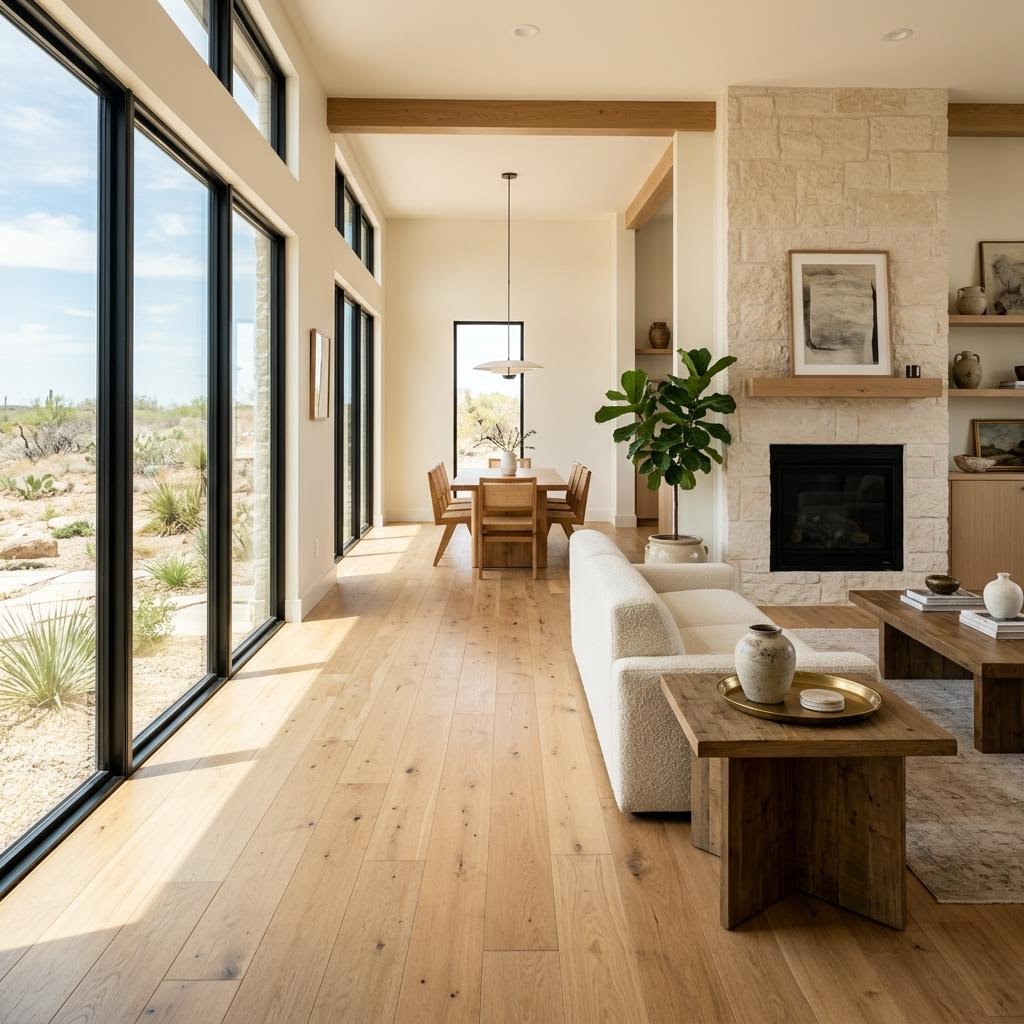
Does a new floor fit the house, or only the showroom display? Look at the home's architecture, permanent finishes, and adjoining rooms before committing to a wood tone, tile pattern, or carpet style.
The right floor provides a foundation that makes a home feel consistent, grounded, and finished.
The Design Gallery provides design-led guidance for selecting flooring that aligns with home construction, personal lifestyle, and existing interior elements throughout the Permian Basin.
Start with the home’s architecture before you fall in love with a sample
A common oversight is selecting flooring in isolation. A sample chosen without context may appear too modern for a bungalow, too rustic for new construction, or overwhelming in a ranch-style layout. Prioritize the architecture of the house before settling on a specific material.
In older bungalows around Odessa and Midland, you’ll usually want flooring that feels warm, character-driven, and scaled appropriately to smaller room sizes. Natural grain patterns, medium-width planks, and tones that complement original trim or built-ins often work better than extra-wide, ultra-trendy gray boards. In ranch homes, the goal is usually visual continuity. These homes often have long sightlines, low profiles, and practical family traffic patterns, so flooring needs to create flow without making the space feel flat or heavy. In newer West Texas construction, you often have higher ceilings, larger rooms, and cleaner lines, which can support wider planks, more contemporary finishes, and a simplified palette.
This is why many homeowners start by exploring complete flooring options for their remodel rather than focusing on color alone. Material, plank width, finish level, and pattern variation all communicate style. A floor that feels timeless in one Odessa neighborhood can feel out of place in another if it doesn’t respect the architecture it’s going into.
A good question to ask is: Does this floor support what my home already wants to be? If the answer is no, that discomfort usually shows up later as regret.
Pair the floor with your furniture, not against it
Flooring covers more visual square footage than any sofa, dining table, or accent wall. That means it should act like a foundation, not a competitor. The right floor allows your furniture, cabinetry, rugs, and lighting to make sense together. The wrong floor creates tension that’s hard to fix.
For example, if your furniture is heavy, dark, and traditional, an extremely pale contemporary floor may make the room feel top-heavy and mismatched. On the other hand, if your style is cleaner and more transitional, a very red or heavily distressed floor can pull the room in a completely different direction. West Texas sunlight also matters here. In Odessa and Midland homes, natural light can brighten undertones you didn’t notice in the showroom, making yellow, pink, or gray notes much stronger once installed.
That’s why showroom designers often recommend selecting flooring only after reviewing the fixed and semi-fixed elements in the home: cabinetry, countertops, wall color, upholstery, and large wood furniture pieces. If you’re considering real hardwood flooring, the species, stain tone, and sheen level all need to coordinate with those elements. If your home needs a more durable option for kids, pets, or heavy traffic, today’s luxury vinyl plank flooring can offer style flexibility while still supporting the overall design.
To coordinate flooring with home architecture successfully, consider these layers:
- Architecture: What era and shape is the home?
- Furniture: Is your style rustic, classic, transitional, or modern?
- Color temperature: Are your finishes mostly warm, cool, or mixed?
- Visual weight: Do you need the floor to soften the room or anchor it?
- Lifestyle: How much traffic, dust, pets, and maintenance will this floor need to handle?
When those layers align, the house feels intentional instead of pieced together.
Choose color and texture for West Texas living, not just showroom lighting
West Texas homes live differently than homes in other parts of the country. Between dry conditions, blowing dust, bright sunlight, and busy family life, your flooring needs to perform as well as it photographs. This is where many good-looking choices become bad long-term choices.
Very dark floors can be beautiful, but in many Permian Basin homes they tend to highlight dust, footprints, and scratches more than homeowners expect. Very light floors can open up a room, but the wrong undertone may look washed out or sterile under Odessa’s strong light. Highly glossy finishes may seem elegant at first, yet they often reveal every bit of daily wear.
In most cases, medium tones and lower-sheen finishes are the safest bridge between beauty and practicality. They hide more of the daily evidence of life while still giving the home a polished appearance. Texture helps too. Subtle grain movement, wire-brushed surfaces, or natural variation can make a floor feel more forgiving and more at home in ranch houses, bungalows, and family-friendly new builds alike.
To create a cohesive aesthetic without adding maintenance stress, avoid chasing trends that appear impressive in a small sample but lose their appeal across an entire home. A floor should anchor the space, not distract from it.
We often tell homeowners in Midland and Odessa that the best flooring choices are usually the ones that still feel right after you imagine them with morning light, evening light, boots at the back door, guests in the living room, and everyday life moving across them for years.
Think room-to-room flow, not just room-by-room decisions
Another common issue is making flooring decisions one room at a time. A homeowner updates the living room now, the bedrooms later, and the kitchen whenever the next phase happens. The result can be too many transitions, too many tones, and a home that never feels fully cohesive.
Especially in Odessa and Midland homes with open layouts or connected common areas, flooring should be evaluated as part of a whole-house experience. That doesn’t always mean every room must have the exact same material, but the transitions should make sense. Bedrooms can be softer and more private while main living spaces stay durable and continuous. The key is consistency in undertone, style language, and visual rhythm.
This is where experienced design guidance matters. A showroom designer can help you decide whether your home calls for one continuous floor, a complementary mix, or a phased plan that still protects the final result. Looking at coordinated flooring solutions early can save costly corrections later.
For many homeowners, intentional planning is the difference between a remodel that feels adequate and one that feels complete. The goal is choosing materials that enhance the home’s existing character.
Ready to Love Your Home Again?
If you are planning a flooring update for a bungalow, ranch home, or new construction in the Permian Basin, The Design Gallery can help coordinate your choice with your architecture and interior decor. Please visit our scheduling page to plan your visit or browse our contact information to learn more.